




consiLetter 10: Determining the combustion factor: Why is it important?
consiletter 10
Determining the combustion factor: Why is it important?
If substances in powder form are used in a production plant, it is essential that these substances be tested with respect to their burning and explosion behavior. An important parameter here is the combustion factor. It is one measurement of how a stored dust ignites and behaves after ignition.
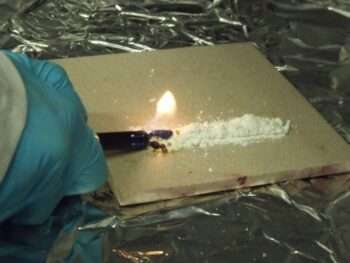
To determine the combustion behavior, the combustion factor of a substance in powder form can be specified as defined in VDI 2263, Part 1. To determine the combustion factor, the test substance is deposited on a ceramic plate in a line approx. 4 cm long and approx. 2 cm wide (2.0 to 8.0 g of the test substance) at ambient temperature. The deposit is then ignited using a glowing platinum wire or a flame as the ignition source and the combustion behavior is designated as a combustion factor between BZ1 and BZ6. Table 1 presents an overview of the definitions of the individual combustion factors.
The combustion behavior is often also of interest at higher temperatures, such as in drying processes. The combustion factor can therefore also be determined at an increased temperature of 100 °C, since there are often significant differences in the combustion behavior here.
If the test substance melts and, due to melting, does not burn, the test is conducted in a mixture with 20 % by weight of diatomaceous earth. The test examines whether product accumulations in porous materials spontaneously combust.
| Combustion factor | Description | Example |
|---|---|---|
| 1 | No ignition | Table salt |
| 2 | Brief ignition and rapid extinguishing | Tartaric acid |
| 3 | Local burning or smoldering with only slight spreading | Lactose |
| 4 | Smoldering without sparks (smoldering fire) or slow decomposition without flames | Tobacco |
| 5 | Spread of open fire or burning with flying sparks | Sulfur |
| 6 | Flash fire or rapid decomposition without flames | Gunpowder |
Combustion behavior is not only of interest in terms of the plant safety concept, however, but also for the classification of solid goods as defined by the transport law, GHS or CLP Regulation. Classification for the transportation of solid substances with regard to their combustion behavior is determined with the help of the burn rate (UN Test N.1).
The combustion factor can also provide valuable information here as well. If, for example, a combustion factor of BZ1 to BZ3 is determined, a self-actuating spread of fire by the test substance is not postulated. Accordingly, test efforts to determine the burn rate (UN Test N.1) can be reduced.
If we can assist you with a similar issue, please contact us. Our experts will be happy to help you.