




consiLetter 9: “Christmas tree safety hazard” – supply line pressure loss before safety valves
consiletter 9
“Christmas tree safety hazard” – supply line pressure loss before safety valves
Where there were not enough free vessel connecting pieces, production plant supply lines for various media frequently used to be connected using T-pieces in so-called “Christmas trees” and routed through a common line on one connecting piece. Since a safety valve ideally never responds, it must – unlike the valves of the supply lines – merely be easily accessible during maintenance, which occurs on average every two years. Thus, safety valves can often be seen as on the picture at the left, connected far to the back of the Christmas tree. In reality, however, in almost every case where this arrangement is used, the pressure loss of the line is too high – except when the nominal size of the “tree” is significantly larger than the nominal inlet size.
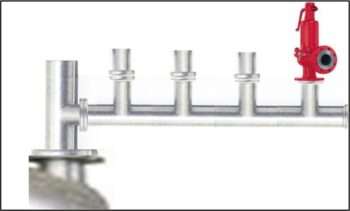
The longer the section of pipeline that the medium must flow through to the inlet of the safety valve, the greater the pressure loss. Each forced change in direction in this area (bend, T-piece) results in additional pressure loss. To limit the pressure loss in the line to the safety valve, the line should therefore be as short as possible and be straight (see illustration below).
The pertinent regulations, such as the AD2000 data sheet A2 or the DIN-EN-ISO 4126 part 9, stipulate the maximum allowable supply line pressure loss in front of safety valves: Pressure loss in the supply line must not exceed 3% of the excess set pressure of the valve. Furthermore, both regulations require that supply lines to safety valves generally be short and – if possible – straight. In addition, pressure loss is to be calculated with the maximum mass flux that can be discharged via the safety valve, which may be significantly greater in some cases than the required mass flux (“to be discharged”) for pressure release.
The necessity of limiting the supply line pressure loss is based on the fact that excessive pressure loss can lead to a high-frequency opening and closing, or “fluttering,” of the safety valve. This fluttering not only prevents reliable operation of the safety valve and reduces the dischargeable mass flux, it can also lead to mechanical destruction of the safety valve and furthermore cause the entire plant to vibrate.
In the case that a longer supply line with changes of direction is necessary for operational reasons, or that a rupture disk or switch valve is to be installed before the safety valve, the supply line to the safety valve must be designed to be one or more nominal sizes larger than the safety valve inlet. If the safety valve is oversized, the dischargeable mass flux of the safety valve can be reduced by using a stroke limitation, thereby reducing supply line pressure loss.
Explanations of vibration behavior of safety valves due to high supply line pressure loss as well as recommendations for avoiding excessive pressure loss are described here, for example (in German):
Westphal, F., Christ, M.: Erfahrungen aus der Praxis mit dem 3 %-Kriterium für die Zuleitungen von Sicherheitsventilen, Technische Sicherheit Bd. 4 (2014), No. 3
If we can assist you with a similar issue, please contact us. Our experts will be happy to help you.